Budgeting Tips for First Home Buyers: Building Your Deposit Faster

Building Your Deposit: Where to Start
Saving for a house deposit in the current Australian market requires more than just skipping the occasional coffee. It demands a strategic shift in how you view your personal finances.
We see first home buyers every day who feel priced out, yet many are closer to purchasing than they realize.
The gap between “renting forever” and “homeowner” is often bridged by understanding government incentives and banking rules, not just raw savings.
We are going to break down the exact numbers you need for 2026. Then we will look at the specific government schemes that can fast-track your entry and the banking loopholes that protect your progress.
Know Your True Numbers (The 2026 Reality)
Most online calculators give you a generic figure. We find that accuracy at this stage prevents panic later.
How Much Do You Actually Need?
The 5% Pathway (First Home Guarantee): You might not need 20%. Under the federal First Home Guarantee (FHBG), eligible buyers can purchase with just a 5% deposit without paying Lenders Mortgage Insurance (LMI). For a $500,000 property, this reduces your upfront target from $100,000 to just $25,000.
The 20% Standard: This is the traditional route to avoid LMI if you do not qualify for government guarantees. On a $500,000 home, this is $100,000.
The “Hidden” Transaction Costs: We cannot stress this enough: you must save for costs on top of the deposit.
- Stamp Duty: In Queensland, the first home concession threshold increased in late 2024. You may pay $0 stamp duty on homes up to $700,000 (check current QLD Revenue Office rates).
- Conveyancing: $1,600 - $2,200.
- Building/Pest Inspection: $600 - $900.
- Government Registration Fees: ~$300 - $500.
- Bank Application Fees: Often waived for first buyers, but budget $600 just in case.
Total Target Example ($500k Home via FHBG): $25,000 (Deposit) + $3,500 (Costs) = $28,500 Total Savings Required.
Your “Genuine Savings” History
Banks look for more than just the final number. They need to see “Genuine Savings.”
This generally means you must show at least 3 months of consistent accumulation or holding of funds. We advise clients to keep their deposit funds in a separate high-interest account to create this digital paper trail.
The 50/30/20 Framework (Adapted for Inflation)
The classic budgeting rule needs a tweak for the current cost of living.
| Category | Percentage | Goal for $6,000/mth Net Income |
|---|---|---|
| Needs | 50-60% | $3,000 - $3,600 |
| Wants | 20-30% | $1,200 - $1,800 |
| Deposit | 20% | $1,200 |
We recommend flipping the “Wants” and “Savings” ratio if you want to buy within 12 months.
Needs (Non-Negotiables)
- Rent
- Groceries (Aldi/Coles/Woolworths)
- Utilities (Electricity/Gas/Internet)
- Transport (Rego, Fuel, Go Card)
- Insurances
Wants (The First to Go)
- Streaming services (Netflix, Stan, Disney+)
- Uber Eats and dining out
- Friday afternoon drinks
- New technology upgrades
Savings (Pay Yourself First)
- House Deposit Account (High Interest)
- Emergency Fund
- Superannuation contributions (FHSS)
Practical Savings Strategies
Quick Wins (The “Lazy Tax” Audit)
1. Energy and Insurance Switch Australians pay a “loyalty tax” for staying with the same provider. We suggest visiting Energy Made Easy (the government comparison site) to find a cheaper plan. A 15-minute phone call to your insurer can often save $200-$400 annually just by asking for a better deal.
2. Audit Your Subscriptions Check your bank statement for “zombie subscriptions.” These are the $14/month charges for apps or streaming services you haven’t opened in weeks. Canceling two of these saves over $330 a year.
3. Unit Pricing at the Supermarket Look at the price per 100g or 100ml on the shelf tag, not the final price. Buying the larger block of cheese or generic brand rice often saves 30-40% per unit. We see families save $50+ per week simply by switching brands.
4. The 48-Hour Pause Implementation is simple: wait two days before buying anything non-essential over $50. The dopamine rush usually fades, and you realize you don’t need the item.

Structural Changes (Big Impact)
1. Housing Hacks Rent is your biggest expense. Consider moving back with family for six months if that is an option, or finding a share house. Saving $200/week on rent puts an extra $10,400 into your deposit fund in one year.
2. Transport Costs Data shows the average Australian household spends over $400 weekly on transport. Using apps like PetrolSpy to find the cheapest fuel can save $0.15-$0.20 per liter. If you are a two-car couple, ask if you can survive with one vehicle for a year.
3. The “Cash Envelope” for Socializing Withdraw your allocated social money in cash at the start of the week. When the cash is gone, the spending stops. Physical cash creates a psychological barrier to spending that tapping a card does not.
Supercharge Savings: The FHSS Scheme
The First Home Super Saver (FHSS) scheme is the most underutilized tool we see.
How it works: You make voluntary pre-tax contributions to your superannuation. These are taxed at 15%, which is likely much lower than your marginal tax rate (32.5% or more). You can then withdraw these voluntary contributions (up to a limit) to buy your house.
The Benefit: This effectively boosts your savings rate by paying less tax. We often see clients gain an extra $4,000 to $6,000 toward their deposit just by using this government structure instead of a regular savings account.
Automation Is Your Best Asset
The “Bucket” Strategy
Willpower is a finite resource. We recommend automating your finances so you don’t have to make decisions on payday.
1. The Firewall Account Open a high-interest savings account at a completely different bank from your daily spending account. Do not get a debit card for this account. If you can’t see the money instantly, you are less likely to spend it.
2. Scheduled Transfers Set up an auto-transfer for the day after your pay clears. Treat your savings contribution like a bill that must be paid. Most successful buyers we work with automate this process completely.
Dealing with Setbacks
The Emergency Buffer
Life will happen while you are saving. We advise keeping $2,000-$3,000 accessible for emergencies (car repairs, medical gaps). Without this buffer, a single flat tire can force you to raid your house deposit, breaking your “Genuine Savings” streak.
Resetting After a Bad Month
You might overspend in December or have a large bill in June. Do not abandon the plan. Simply review the numbers, adjust your timeline by a few weeks if necessary, and restart the automation.
Visualizing the Finish Line
Track Net Worth, Not Just Savings
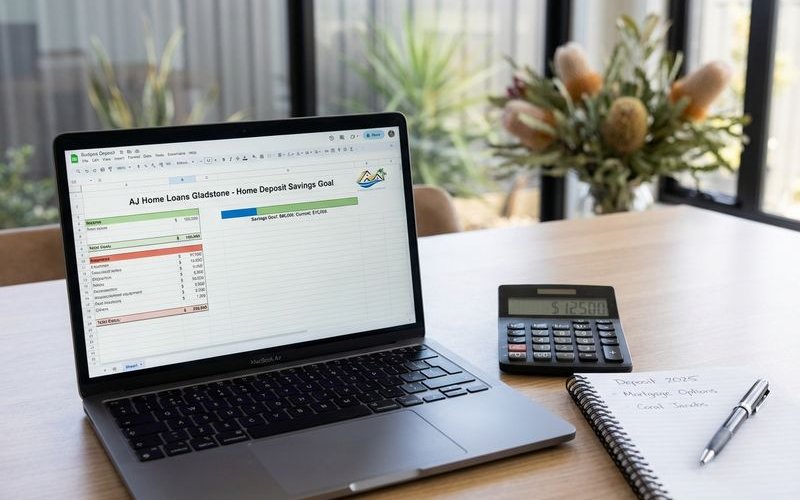
Your deposit is growing, but so is your super and potentially other assets. We suggest using a simple spreadsheet or a chart on the fridge. Coloring in a progress bar for every $1,000 saved provides a dopamine hit that keeps you motivated.
Quarterly Reviews
Sit down every three months to check your progress. Ask yourself: “Has my income changed?” or “Have expenses risen?” Adjust your auto-transfers accordingly.
Gladstone-Specific Market Advantage
Affordability vs. Capital Cities
Gladstone offers a significant entry point advantage. While Brisbane median prices hover near $800,000+, Gladstone offers quality detached homes in the $350,000 - $480,000 range. This lower entry price means your deposit hurdle is literally half that of a capital city buyer.
The Resources Sector Boost
Many of our local clients work in the industrial or resources sector. If you receive roster bonuses or overtime, transfer 100% of that “extra” income directly to your deposit. Living on your base salary and saving the rest is the fastest way to homeownership in this region.
Rental Market Strategy
Rents in Gladstone are rising, but they remain competitive compared to the coast. We suggest locking in a longer lease if possible to stabilize your expenses while you save. Knowing your rent is fixed for 12 months allows for accurate forecasting.
Common Budgeting Traps
1. The “Too Strict” Diet
Financial burnout is real. Budget 5% for “guilt-free fun” so you don’t snap and blow $500 on a weekend.
2. Ignoring Annual Expenses
Car registration ($800+) and Christmas gifts ($500+) are not surprises; they happen every year. Divide these totals by 12 and set that money aside monthly.
3. Vague Goal Setting
“I want to buy a house” is a wish. “I need $32,000 by November 2026” is a plan. Specific numbers drive specific actions.
4. Comparison Syndrome
Your friend might have had help from parents. Focus strictly on your own income and savings rate.
5. Forgetting the “Move-In” Fund
You need money for the moving truck, internet connection fees, and that first trip to Bunnings. We recommend having an extra $1,500 set aside for the first week in your new home.
The Pre-Approval Advantage
Saving is only half the battle. Getting pre-approved gives you a “hunting license” for the property market.
Why do it early?
- It confirms your borrowing power matches your savings goal.
- It highlights any credit file issues early (like that missed phone bill from 3 years ago).
- It makes your offer stronger when you find the right house.
We can run a borrowing capacity calculation for you even if you are six months away from buying.
How AJ Home Loans Supports You
We do not just arrange the loan; we help you build the roadmap to get there.
- Reverse Engineering: We take your target purchase price and work backward to set your weekly savings goal.
- Grant Optimization: We check your eligibility for the First Home Guarantee, FHOG, and Stamp Duty Concessions.
- Accountability: We can set quarterly check-ins to keep your savings on track.
- Market Reality Checks: We provide real data on what your deposit will actually buy in the current Gladstone market.
Start Your Journey Today
The best time to start saving was yesterday; the second best time is today. You are likely closer to your first home than you think, especially with the right government schemes.
Book a free strategy session with us. We will look at your current numbers, identify your best deposit strategy, and get you moving toward your own front door.
Tags
Coral Jacobs
Senior Mortgage Broker at AJ Home Loans Gladstone
Related Articles

Buying Property at Auction: A Queensland Buyer's Guide
Complete guide to buying property at auction in Queensland. Understand the process, prepare properly, and avoid costly mistakes.

Should You Get a Car Loan Through a Mortgage Broker?
Discover why mortgage brokers offer car loans, the benefits of using a broker for vehicle finance, and how it compares to dealer finance.

Construction Loan Process Explained: Building Your New Home
Complete guide to construction loans in Australia. Understand progress payments, fixed price contracts, owner-builder requirements and the build process.