
Understanding Credit Scores in Australia
We find that most Australians view their credit score as a simple pass or fail grade. The reality is more nuanced.
In Australia, the system uses a numerical value to represent your creditworthiness based on your history with lenders. Equifax, the largest bureau here, uses a scale from 0 to 1,200. Other bureaus like Illion and Experian typically cap their scores at 1,000.
A higher number generally indicates lower risk to a bank.
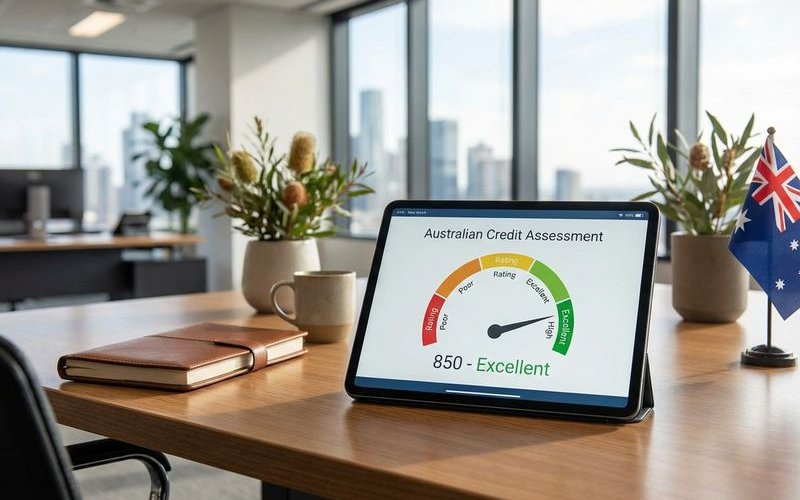
We track recent data showing the average Australian credit score sits around 846 according to Equifax. If your number falls significantly below this benchmark, you might face higher interest rates or stricter lending criteria.
What’s in Your Credit Report?
Your credit report contains much more than just a single number. We analyze these documents daily and see that lenders focus heavily on “Comprehensive Credit Reporting” (CCR) data.
This file includes:
Identity Information
- Name, current address, and previous addresses
- Employment history reported by lenders
- Driver’s licence details
Credit Enquiries
- Every application for credit (loans, credit cards, utilities)
- Records remain on your file for 5 years
- Recent patterns of multiple enquiries often trigger automatic declines
Credit Accounts (CCR Data)
- Open and closed accounts for credit cards, personal loans, and mortgages
- Account limits (not just what you owe, but the maximum you can borrow)
- Dates the accounts were opened and closed
Defaults and Serious Issues
- Defaults of $150 or more that were overdue by 60 days
- Court judgments
- Bankruptcies and Part 9 Debt Agreements
Repayment History Information (RHI)
- A 24-month rolling record of whether you paid on time
- Specific codes indicating if a payment was 14, 30, 60, or 90 days late
- This section is crucial because one missed payment remains visible for two years
How Credit Scores Affect Home Loans
We see a direct correlation between your score and the interest rate you pay. Lenders categorize borrowers into risk tiers based on this data.
Prime Lenders (Major Banks)
Most major banks and tier-one lenders require a clean file.
- Score Requirement: Typically above 600-650 depending on the bureau.
- History: No defaults or judgments in the last 5 years.
- RHI: A perfect 24-month repayment history is usually non-negotiable.
These institutions offer the lowest advertised rates.
Near-Prime Lenders
We often utilize these lenders for clients with minor credit hiccups.
- Score Requirement: generally 500-600.
- Flexibility: Small paid defaults (under $1,000) may be accepted.
- Allowances: One or two isolated late payments might be overlooked with a strong explanation.
Interest rates here currently sit approximately 0.50% to 1.50% higher than standard variable rates.
Specialist Lenders
For borrowers with significant impairments, specialist lending is a vital pathway.
- Score Requirement: Scores below 500 are considered.
- Issues Accepted: Recent or unpaid defaults, discharged bankruptcy, or tax debt.
- Strategy: These loans are intended as short-term solutions (1-3 years) to stabilize your position before refinancing.
The cost of funds is higher to offset the lender’s risk.
| Lender Tier | Typical Score | Rate Premium | LVR Limit (Typical) |
|---|---|---|---|
| Prime | 650+ | Standard Market Rate | Up to 95% |
| Near-Prime | 500-650 | +0.5% to 1.5% | Up to 90% |
| Specialist | Below 500 | +1.5% to 4.0% | Up to 80-85% |
What Damages Your Credit Score
We advise clients to protect their credit file aggressively because negative events stick for years. Understanding what hurts your score allows you to avoid accidental damage.
High Impact Negatives
Defaults:
- Occurs when a payment over $150 is overdue by 60 days or more.
- Remains on your report for 5 years.
- A single default can drop a score by 200+ points instantly.
Court Judgments:
- Result from a creditor taking legal action to recover debt.
- Remains on your report for 5 years.
- Many prime lenders have an automated policy to decline any file with a judgment.
Bankruptcy:
- The most severe credit event possible.
- Remains on your report for 5 years or 2 years from discharge (whichever is later).
- Access to finance is severely restricted during the bankruptcy period.
Medium Impact Negatives
Late Payments (RHI):
- Reported if a payment is more than 14 days late.
- A “1” on your report means 0-29 days late; higher numbers indicate longer delays.
- Remains visible for 2 years.
High Credit Utilisation:
- Consistently maximizing your credit card limit suggests financial stress.
- We recommend keeping balances below 30% of the limit to support a healthy score.
Multiple Credit Applications:
- Every application lowers your score slightly.
- Applying for 3-4 loans in a short period signals desperation to credit algorithms.

Lower Impact Negatives
Address Instability:
- Moving house frequently can lower your “stability score” internally with banks.
- Lenders prefer to see at least 3 years of residential history.
Short Credit History:
- Young borrowers or new migrants often have “thin files.”
- A lack of data is better than bad data, but it may limit access to automated approvals.
Common Credit Mistakes
We frequently see applicants sabotage their own chances through simple errors. Avoiding these pitfalls puts you ahead of the pack.
1. Not Checking Your Report
Statistics show that nearly 1 in 5 credit reports contain errors. We have seen clients declined for million-dollar loans because of a $150 erroneous energy bill default from three years ago.
2. Closing Old Credit Cards
Older accounts anchor your credit history age. Closing your oldest card lowers the average age of your credit accounts, which can result in a score drop.
3. Multiple Loan Shopping
Homeowners often think applying with four banks allows them to compare rates. Each application leaves a “hard enquiry” footprint. A broker can run “soft checks” or scenario assessments that do not impact your score.
4. Ignoring Small Debts
That $200 disputed phone bill often turns into a default. Telcos and utility providers are the most common source of defaults we see. It is safer to pay the bill first and dispute the refund later.
5. Buy Now Pay Later (BNPL) Issues
Many users do not realize BNPL services like Afterpay or Zip can impact borrowing capacity. Some lenders now view these limits as credit cards, and missed payments are increasingly being reported to bureaus under the new reporting framework.
How to Check Your Credit Score
We recommend checking your file directly with the source rather than relying solely on third-party marketing apps.
In Australia, you can get a free credit report from:
- Equifax - equifax.com.au
- Experian - experian.com.au
- illion - illion.com.au
Australian law entitles you to one free report every 3 months from each bureau. You can also request a free copy within 90 days of being declined for credit.
Improving Your Credit Score
We help clients build a roadmap to credit recovery. While there are no instant fixes, taking specific actions yields results over time.
Short-Term Improvements (1-3 months)
- Audit for errors and lodge disputes immediately for any duplicate listings.
- Pay down high balances to lower your utilization ratio below 30%.
- Request limit decreases on unused credit cards to boost borrowing power.
- Halt all applications to let your enquiry profile stabilize.
Medium-Term Improvements (3-12 months)
- Automate payments to ensure the last 6 months of Repayment History Information (RHI) are perfect.
- Clear small debts to reduce the number of active credit lines.
- Pay more than the minimum on credit cards to demonstrate surplus income.
- Stabilize your data by not moving house or changing jobs if a loan application is imminent.
Long-Term Improvements (1-2 years)
- Let negatives age because the impact of a default lessens as it gets older.
- Demonstrate stability with consistent employment and savings records.
- Diversify credit responsibly by managing a mix of credit types over a long period.
Credit Repair: Does It Work?
We advise extreme caution regarding “credit repair” agencies. Many charge high upfront fees for things you can do yourself.
Legitimate services can:
- Assist in disputing factually incorrect listings.
- Negotiate payment plans with creditors.
- Identify procedural errors creditors made when listing a default.
They cannot:
- Erase a default that is factually true and procedurally correct.
- Guarantee a score increase in a specific timeframe.
- Remove bankruptcy records legally.
Australian consumers can dispute errors for free through the Australian Financial Complaints Authority (AFCA) if a lender refuses to correct a mistake.
Lender Policies on Credit Issues
We work with a panel of over 30 lenders, and each views risk differently. A decline from one bank does not mean you cannot get a loan.
Paid Defaults
- Many non-conforming lenders will accept paid defaults if they occurred over 24 months ago.
- The total value of the default usually needs to be under $1,000 for standard consideration.
- A written explanation of the event is mandatory.
Telecommunications Defaults
- Lenders often view telco defaults as less severe than missed loan payments.
- We must provide evidence that the debt has been paid in full.
- The score will still be lower, but the application can often proceed.
Multiple Enquiries
- Exceeding 4 enquiries in 6 months is a major red flag.
- We mitigate this by explaining the reason, such as shopping for a specific car or refinancing.
- Broker-initiated enquiries are sometimes viewed more leniently than direct consumer applications.
Previous Mortgage Conduct
- Your track record with previous home loans is the single most important factor.
- A single late payment on a mortgage is viewed more negatively than a default on a phone bill.
- Lenders want to see 6 months of perfect mortgage statements before refinancing.
Gladstone-Specific Considerations
Our team understands the unique economic rhythm of the Gladstone region. Local factors often influence credit profiles in ways big city algorithms miss.
Resources Industry Redundancy: We often see credit dips that coincide with shutdowns or downturns in the local resources sector. Lenders are more likely to accept a past default if we can prove it was caused by an industry-wide redundancy and you are now back in stable work.
FIFO Lifestyle: Roster cycles can sometimes cause accidental missed payments if internet access is limited on site. We advise setting up direct debits to prevent RHI damage while working remote shifts.
New to the Region: Moving to Gladstone for work creates a “new address” alert on your file. We work with lenders who prioritize your employment contract and income stability over your time at a specific address.
What We Do for Clients with Credit Issues
At AJ Home Loans, we specialize in turning “no” into “yes.” We take a forensic approach to your application.
- Review your credit report to identify exactly which bureau data is causing the issue.
- Identify errors and guide you through the free dispute process with AFCA if necessary.
- Match you with lenders who have an appetite for your specific risk profile.
- Structure your application to emphasize your income, assets, and stability.
- Create a transition plan to get you into the market now and refinance to a prime rate once your credit heals.
A lower score might mean a temporary premium on your rate, but it doesn’t have to stop you from buying a home.
Get Your Credit Assessment
You do not need to guess where you stand with the banks. We can access your report without damaging your score and provide a clear path forward.
Book a free consultation today. Our team will review your situation and outline your best options for securing a home loan.
Tags
Coral Jacobs
Senior Mortgage Broker at AJ Home Loans Gladstone
Related Articles

Budgeting Tips for First Home Buyers: Building Your Deposit Faster
Practical budgeting strategies to help first home buyers save for a deposit faster while managing everyday expenses.

Buying Property at Auction: A Queensland Buyer's Guide
Complete guide to buying property at auction in Queensland. Understand the process, prepare properly, and avoid costly mistakes.

Should You Get a Car Loan Through a Mortgage Broker?
Discover why mortgage brokers offer car loans, the benefits of using a broker for vehicle finance, and how it compares to dealer finance.