
Most borrowers we speak with view offset accounts and redraw facilities as interchangeable features.
It is easy to see why since both options reduce the interest charged on your home loan.
We find that treating them as identical is a costly mistake.
The difference lies in how the bank legally treats your money and how the Australian Taxation Office (ATO) views it.
Our team sees this distinction become critical when clients decide to upgrade their home or convert a property into an investment.
Let’s break down the mechanics, the specific tax risks, and the practical features to help you decide which structure fits your long-term wealth plan.
Understanding Offset and Redraw
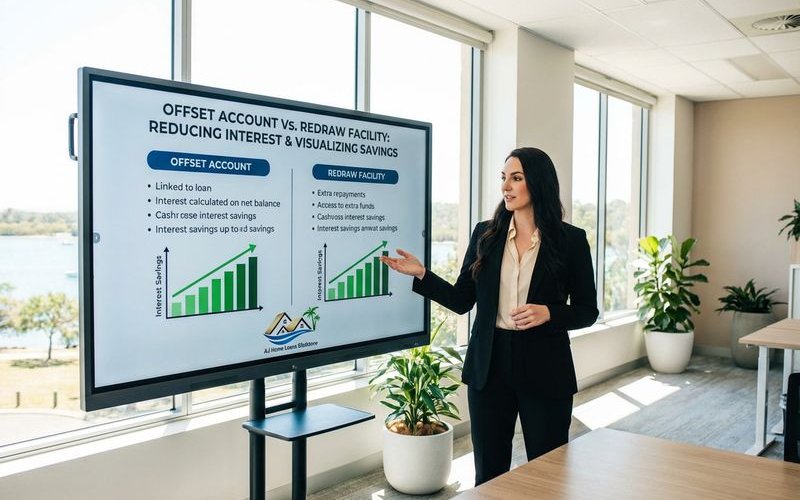
Both offset accounts and redraw facilities utilize your surplus cash to lower interest costs.
While the mathematical outcome on your monthly statement looks the same, the legal structure is completely different.
An offset is a separate savings account, whereas a redraw is a feature of the loan itself where you have paid back the principal ahead of schedule.
How an Offset Account Works
An offset account is a fully functional transaction account linked directly to your mortgage.
The bank looks at the balance in this account and subtracts it from your loan balance before calculating your daily interest.
The Financial Mechanics
- Loan balance: $400,000
- Offset account balance: $50,000
- Interest calculated on: $350,000 ($400,000 minus $50,000)
If your interest rate is 6.00% (a common variable rate in current market conditions), you save significant money.
- $50,000 × 6.00% = $3,000 per year in interest.
- This equates to roughly $250 per month in pure savings.
Why We Like Offset Features
Our clients often prefer offsets because the money remains legally theirs.
It is not considered a loan repayment.
This distinction is vital for liquidity.
- FCS Protection: Because an offset is a deposit account, it is typically protected by the Australian Government’s Financial Claims Scheme (FCS) up to $250,000 per account holder per institution.
- Instant Access: You can access funds via ATMs, debit cards, or the New Payments Platform (Osko) instantly.
- No Approvals: The bank cannot generally block you from accessing these funds as they are your savings.
How a Redraw Facility Works
A redraw facility is not a bank account.
It is a feature that allows you to borrow back extra principal repayments you have made over and above your minimum required payments.
When you put money into redraw, you are technically paying off the debt.
The Redraw Example
- Original loan: $400,000
- Extra repayments made: $50,000
- Current loan balance: $350,000
- Available redraw: $50,000
You can “redraw” that $50,000 if required, which pushes your loan balance back up to $400,000.
Critical Redraw Limitations
We advise caution here because the bank technically owns this money until you withdraw it.
Some lenders have policies that can catch borrowers off guard.
- Amortization Limits: Some loan contracts allow the lender to reduce your available redraw limit as the loan term progresses so the loan finishes on time.
- Access Delays: Unlike an offset account, redraws often require an internet banking transfer that can take 1-2 business days depending on the lender’s technology.
- System Freezes: In rare cases of financial instability or system errors, banks can temporarily freeze redraw access.
Key Differences at a Glance
| Feature | Offset Account | Redraw Facility |
|---|---|---|
| Legal Status | Separate Savings Account | Principal Loan Repayment |
| Government Guarantee | Covered by FCS (up to $250k) | Not covered (it’s a debt reduction) |
| Access Speed | Instant (Card/Osko) | Varies (Instant to 2 days) |
| Fees | Often $395/year (Package fee) | Usually $0 |
| Tax Impact | Preserves tax deductibility | Can contaminate loan deductibility |
| Bank Control | Low (Your money) | Higher (Bank’s discretion) |
The Important Tax Consideration
This is the single most important section for anyone who might turn their current home into an investment property in the future.
The ATO views these two facilities very differently regarding tax deductibility.
The Scenario: Converting Home to Investment
Imagine you have a $400,000 loan on your home and you have saved $100,000.
You decide to move out, buy a new house, and rent out your old one.
You need that $100,000 cash for the deposit on your new home.
Outcome With an Offset Account
- You withdraw $100,000 from the offset account to pay for your new home deposit.
- Your investment loan balance effectively jumps from $300,000 (net) back to $400,000.
- The Result: The ATO generally accepts that the full $400,000 is an investment loan.
- The Benefit: You can claim tax deductions on the interest for the full $400,000.
Outcome With a Redraw Facility
- You redraw $100,000 from the loan.
- The ATO views this redraw as “new borrowing.”
- Because you used this new borrowing for a personal purpose (buying a new private home), the interest on that $100,000 is generally not tax-deductible.
- The Result: You can only claim interest on the remaining $300,000 balance.
- The Cost: You lose tax benefits on 25% of your loan for the life of the investment.
We see this mistake cost investors thousands of dollars in unclaimed tax deductions every single year.
If there is even a slight chance your home will become a rental, an offset account is essentially an insurance policy for your future tax deductions.

Cost Comparison
Offset Account Costs
Offset accounts are premium products.
Banks often package them with an annual fee, commonly around $395 for a “Wealth Package” with the major Australian banks.
- Annual Fee: Typically $395 (though some non-major lenders offer them for $10/month or free).
- Interest Rate: Loans with offsets sometimes carry a slightly higher interest rate than “basic” loans.
Redraw Costs
Redraw is usually a standard feature on “Basic” variable loans.
- Annual Fee: usually $0.
- Transaction Fees: Most modern loans offer free online redraws, though some older products may charge $10-$25 for staff-assisted redraws.
The Breakeven Calculation
Is paying a $395 annual fee worth it?
If your interest rate is 6.00%, you need to save more than the fee in interest.
- Math: $395 divided by 0.06 = $6,583.
This means if you keep an average balance of $6,583 or more in your offset, the interest savings pay for the fee.
Everything above that amount is pure profit.
Which is Better for You?
Choose an Offset Account If:
- You have an Investor Mindset: You want to preserve the future tax deductibility of the debt.
- You Value Liquidity: You need instant access to cash via a debit card for emergencies or daily spending.
- Your Savings Exceed $10,000: The interest savings will easily outweigh the annual package fees.
- Family Help: You are using parents’ savings to help offset interest (possible with some lenders’ “Family Offset” products).
Choose Redraw If:
- You are Debt-Focused: Your only goal is to pay off the house and live in it forever.
- Your Balance is Low: You typically have less than $5,000 in savings, so the annual fee isn’t justified.
- You Need Discipline: You want to make the money “harder to get” to avoid impulsive spending.
- Simplicity is Key: You prefer a “set and forget” basic loan with no fees.
The Hybrid Strategy
We often structure loans to utilize both.
You can have a portion of your loan fixed (no offset) and a portion variable with an offset account for your daily savings.
This gives you rate certainty on one side and flexibility on the other.
Real Interest Savings
Let’s look at the numbers on a typical Australian mortgage in 2026 terms.
The Scenario:
- $400,000 loan
- 6.00% Interest Rate
- 30-year term
Standard Path (No Extra Savings):
- Monthly Repayment: $2,398
- Total Interest Paid: $463,353
With $30,000 Average Balance (Offset or Redraw):
- Interest is calculated on $370,000.
- Total Interest Paid: Approximately $379,000.
- Total Saving: ~$84,000.
- Time Saved: You enter the debt-free phase roughly 3 years and 4 months earlier.
The financial outcome is identical in both scenarios.
You are paying for the access and the tax structure, not the interest saving itself.
Practical Tips
For Offset Account Users:
- Consolidate Savings: Move your emergency fund, holiday savings, and tax provisions into the offset. Every dollar counts daily.
- Credit Card Strategy: Use an interest-free credit card for monthly expenses and leave your cash in the offset until the due date. This keeps your offset balance higher for 55 days longer.
For Redraw Users:
- Automate It: Set your direct debit slightly higher than the minimum. Even $50 extra a week builds a redraw buffer rapidly.
- Check Policies: Verify if your lender has a “minimum redraw amount” (often $500) so you don’t get stuck unable to access smaller amounts of cash.
Regional Queensland Context
For our clients in Gladstone and regional Queensland, local economic factors play a role in this decision.
Mining and Resources Workers: We see FIFO workers dealing with high overtime variance.
An offset account is superior here because it smoothes out irregular cash flow without locking the money away.
You can park big checks in the offset during boom times and draw down instantly during shutdowns or roster changes.
Small Business Owners: Many local contractors face lumpy invoicing cycles.
Keeping your tax provisions (GST/PAYG) in a personal offset account (check with your accountant first) can save you personal mortgage interest while the money sits waiting for the ATO.
Growing Families: Gladstone holds a younger demographic.
The flexibility of an offset suits families who might need sudden access to $5,000 for a new car or medical costs without waiting for a bank approval process.
Making the Right Choice
At AJ Home Loans, we focus on matching the loan feature to your behavior, not just the interest rate.
The “best” option is the one that gives you the most control.
If you are disciplined and never plan to rent out your home, redraw is a free and effective tool.
If you value flexibility and want to keep your investment options open, the offset account is the industry standard for a reason.
Get Advice on Loan Features
Offset accounts and redraw facilities are just two levers we can pull to optimize your mortgage.
The right structure can save you tens of thousands of dollars over the life of your loan.
Book a free consultation and we will review your current setup to ensure your loan is working as hard as you are.
Tags
Coral Jacobs
Senior Mortgage Broker at AJ Home Loans Gladstone
Related Articles

Budgeting Tips for First Home Buyers: Building Your Deposit Faster
Practical budgeting strategies to help first home buyers save for a deposit faster while managing everyday expenses.

Buying Property at Auction: A Queensland Buyer's Guide
Complete guide to buying property at auction in Queensland. Understand the process, prepare properly, and avoid costly mistakes.

Should You Get a Car Loan Through a Mortgage Broker?
Discover why mortgage brokers offer car loans, the benefits of using a broker for vehicle finance, and how it compares to dealer finance.