Self-Employed Home Loan Guide: Getting Approved as a Business Owner

Home Loans for Self-Employed Borrowers
You know how it feels when you try to fit a square peg into a round hole? That is exactly what it’s like for many business owners trying to get a home loan through a standard banking algorithm.
The banks love consistency, and let’s be honest, running a business is rarely a straight line.
From what we’ve seen in the 2026 lending landscape, the good news is that policies are finally catching up to reality. We are seeing more lenders move away from rigid checkboxes and towards a common-sense assessment of your actual cash flow.
In this guide, we are going to break down the specific documents you need, the “add-back” tricks that boost your borrowing power, and the new rules affecting business owners right now.
Why Self-Employed Lending is Different
When you are an employee, a lender just looks at your payslip and assumes that money will keep hitting your account forever.
For us self-employed folks, lenders look at the past to predict the future. They are trying to answer four specific questions:
- Stability: Have you survived the startup phase (usually 2 years)?
- Solvency: Is the business actually profitable, or just turning over cash?
- Sustainability: Is your current income level likely to continue?
- Conduct: Do you pay your business debts (ATO, suppliers) on time?
This means they need to dig deeper than just a single number on a tax return.
The Impact of Comprehensive Credit Reporting (CCR)
One thing many applicants miss is that lenders now see everything.
Through Comprehensive Credit Reporting, a lender can see if you missed a repayment on your business credit card last month, even if you caught up a week later. Clean conduct on all your accounts for the last 6 months is non-negotiable for the best rates.
Types of Self-Employment
Lenders view different business structures differently, and your structure dictates which documents you need.
Sole Trader
- The Reality: You and the business are the same entity.
- The Lender View: This is the easiest structure to assess.
- Key Requirement: Most lenders want to see your individual tax returns.
Partnership
- The Reality: You share control and liability with others.
- The Lender View: They need to verify your specific share of the profit.
- Key Requirement: We often need to provide the partnership agreement to prove your percentage of ownership.
Company Director
- The Reality: The company is a separate legal entity.
- The Lender View: You might pay yourself a small salary to minimize tax, but the company makes a huge profit.
- Key Requirement: We need both company financials and your personal tax returns to show the “full picture” of your earnings.
Trust Beneficiary
- The Reality: Used for asset protection and tax flexibility.
- The Lender View: This is the most complex structure because distributions can change yearly.
- Key Requirement: The Trust Deed is essential here so the lender can see who has the power to distribute income.
PAYG Contractor
- The Reality: You invoice an agency or company but work like an employee.
- The Lender View: Some lenders will treat you as a standard employee if you have a 6-month history.
- Key Requirement: Your current contract and 3 months of bank statements.
Documentation Requirements
Standard Self-Employed (Full Doc)
This path offers the lowest interest rates because you are proving everything.
The 1-Year Financials Trend Historically, banks wanted a 2-year average. However, in 2025 and 2026, major lenders like ANZ, NAB, and Westpac have shifted policies.
If your business has been registered for 2 years but you only have 1 year of strong financials, many lenders will now use just that most recent year. This is massive if your business grew significantly in the last 12 months.
Standard Checklist:
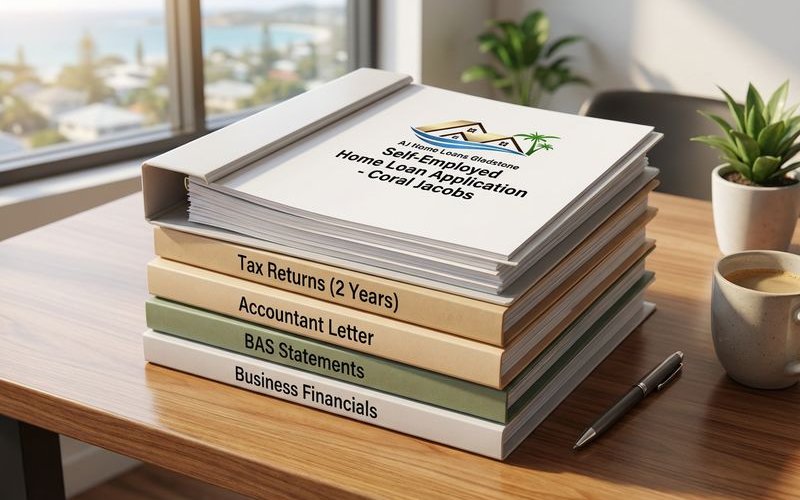
- Last 2 years of personal tax returns.
- Last 2 years of Notice of Assessments (NOA) from the ATO.
- Last 2 years of business financials (Profit & Loss + Balance Sheet).
- Current ABN registration details.
”Alt Doc” Loans (Formerly Low Doc)
The industry has moved away from the term “Low Doc” because it implies high risk. We now call these “Alt Doc” (Alternative Documentation) loans.
These are perfect if your tax returns haven’t been lodged yet or don’t reflect your current trading reality.
Verification Options:
- BAS Statements: Provide 12 months of Business Activity Statements to show turnover.
- Business Bank Statements: 6 months of main business account statements.
- Accountant’s Letter: A signed declaration from your accountant confirming your income.
| Loan Type | Best For | Rate Impact | Max LVR |
|---|---|---|---|
| Full Doc | Borrowers with up-to-date, strong tax returns. | Standard Market Rates | 95% |
| Alt Doc (BAS) | High turnover businesses with complex deductions. | +0.40% - 0.90% | 80% |
| Alt Doc (Bank Statements) | Cash-flow strong businesses without recent tax returns. | +0.70% - 1.20% | 80% |
| Lease Doc | Commercial property investors (uses rental income only). | +1.00% - 1.50% | 70% |
How Income is Calculated
This is the secret sauce of self-employed lending. Your “Taxable Income” is almost never your “Borrowing Income.”
A good broker will fight to add back “paper expenses” that reduce your tax bill but don’t actually cost you cash.
The “Add-Back” Concept
Lenders understand that you legally minimize tax. We help them reverse that process to maximize your loan size.
Standard Add-Backs We Use:
- Depreciation: This is a paper loss on assets, not cash leaving the bank.
- Interest Expenses: If you are refinancing a business loan into the home loan, this interest is added back.
- Superannuation: Any contributions made above the mandatory 11.5% (or current statutory rate) are voluntary and added back.
- One-Off Expenses: Did you buy a new work truck or pay for a website redesign? We can argue these are one-time costs, not ongoing expenses.
- Instant Asset Write-Off: Similar to depreciation, this reduces tax but doesn’t reflect ongoing costs.
The Difference in Action Imagine a plumber with a net profit of $80,000.
| Item | Tax Return View | Lender “Add-Back” View |
|---|---|---|
| Net Profit | $80,000 | $80,000 |
| Depreciation | -$25,000 (Expense) | +$25,000 (Income) |
| Voluntary Super | -$15,000 (Expense) | +$15,000 (Income) |
| One-Off Tool Purchase | -$10,000 (Expense) | +$10,000 (Income) |
| Total Assessable Income | $80,000 | $130,000 |
This $50,000 difference can increase your borrowing power by over $250,000.

Common Challenges for Self-Employed
Challenge 1: The “20% Variance” Rule
Lenders hate volatility. If your income jumps from $100,000 in Year 1 to $200,000 in Year 2, they get nervous.
The Fix: Most lenders will cap the growth at 20% unless we can provide a rock-solid explanation. We often use contracts or client retainer agreements to prove the new higher income is the “new normal.”
Challenge 2: Tax Minimisation
Your accountant wants to show $0 profit to pay $0 tax. Your mortgage broker wants to show maximum profit to buy a dream home.
The Fix: You need to plan this 12 months out. We often work directly with your accountant to find a middle ground where you pay a bit more tax for one year to lock in a 30-year asset.
Challenge 3: ATO Debts
If you have a payment arrangement with the ATO, many major banks will decline your application instantly.
The Fix: Some non-bank lenders allow ATO debts if they are being paid out by the new loan. Alternatively, clearing this debt is often the first step before applying.
Challenge 4: APRA’s Debt-to-Income (DTI) Cap
Starting February 2026, APRA has strictly enforced a limit where your total debt cannot exceed 6 times your income for most new loans.
The Fix: Business owners often have business debts that bloat this ratio. We can sometimes exclude business debts from this calculation if they are serviced by the business cash flow, not your personal wage.
Tips for Self-Employed Borrowers
Before Applying
1. Tidy Up Your Bank Statements: Lenders use bots to scan your statements. Cancel unused subscriptions, avoid overdrawing your account, and stop any gambling transactions at least 3 months before applying.
2. Lodge Your BAS on Time: Even if you haven’t paid the bill yet, lodging on time shows “good conduct.” Late lodgements are a major red flag.
3. Check Your Credit Score: Download your free credit report from Equifax or Illion. You want to see a score above 650 for prime lending.
4. Keep Business and Personal Separate: Don’t buy groceries on the business card. It makes the assessment messy and forces the lender to treat personal expenses as business costs.
During Application
1. Have Your “Story” Ready: If your income dropped in 2024, why? Was it a renovation, a sabbatical, or a market downturn? A clear, honest narrative helps the credit assessor say “yes.”
2. Prepare the Accountant’s Letter: We can provide a template for this. It needs to confirm you are not trading insolvently and that the new loan won’t hurt the business cash flow.
3. Be Quick with Documents: Assessors are busy. If they ask for a document and you take 5 days to send it, your file goes to the bottom of the pile.
Gladstone Self-Employed Considerations
For our local clients here in Central Queensland, the economy has its own unique rhythm.
Mining and Resources Contractors
If you contract to sites like Curtis Island or the mines:
- Contract Clarity: Lenders prefer seeing a history of contract renewals.
- Overtime/Allowances: We need to show these are consistent, not just a one-off.
Trade Business Owners
For the plumbers, sparkies, and builders in the region:
- QBCC Requirements: Your license must be active and free of demerit points.
- Subcontractor Expenses: Lenders check if your “Employees” are actually subbies, which changes your risk profile.
Retail and Hospitality
- Seasonality: We know January and February can be quiet in Gladstone. We present annualized figures to smooth out these seasonal bumps.
Low Doc Loans: When They Make Sense
Low Doc (or Alt Doc) loans are not “bad” loans; they are strategic tools.
Good Candidates:
- You have a large deposit (20% or more).
- Your tax returns are complex or delayed.
- You need speed and can’t wait for the accountant.
The Cost of Convenience: Expect to pay an interest rate that is 0.50% to 1.50% higher than a standard loan. Also, watch out for “Risk Fees” or “Application Fees” which can sometimes be 0.5% of the loan amount.
Our Strategy: We often use an Alt Doc loan to get you into the property now. Then, once your tax returns are up to date in 12-24 months, we refinance you to a prime “Full Doc” loan at a lower rate.
How We Help Self-Employed Clients
Our home loans service speaks the language of business owners.
We start by analyzing your financials exactly as a credit assessor would, identifying potential add-backs before we even select a lender.
Next, our team matches your specific profile—whether you are a sole trader with one year of history or a complex family trust—to the lender with the most favorable policy for that structure.
We handle the aggressive questioning from the banks. You focus on running your business while we argue the case for your income sustainability.
Finally, we guide you through the long-term strategy, ensuring this loan structure doesn’t handcuff your future business growth.
Get Self-Employed Finance Advice
Self-employed lending requires specialist knowledge. The wrong lender or approach can mean unnecessary rejection or paying too much.
Book a free consultation to discuss your business structure, income, and borrowing goals. We’ll tell you exactly what’s possible and how to get there.
Tags
Coral Jacobs
Senior Mortgage Broker at AJ Home Loans Gladstone
Related Articles

Budgeting Tips for First Home Buyers: Building Your Deposit Faster
Practical budgeting strategies to help first home buyers save for a deposit faster while managing everyday expenses.

Buying Property at Auction: A Queensland Buyer's Guide
Complete guide to buying property at auction in Queensland. Understand the process, prepare properly, and avoid costly mistakes.

Should You Get a Car Loan Through a Mortgage Broker?
Discover why mortgage brokers offer car loans, the benefits of using a broker for vehicle finance, and how it compares to dealer finance.