
Understanding home loan interest rates is the single most effective way to lower your monthly mortgage costs. Most borrowers look only at the advertised number, missing the hidden fees and structural factors that actually determine what they pay.
We see this confusion every day in our consultations. A client might celebrate a low headline rate, only to realize later that the comparison rate is significantly higher due to fees. Our goal is to strip away the jargon and show you exactly how the banks price your loan.
In this guide, we will break down the mechanics of bank pricing, expose the flaws in standard comparison rates, and explain the specific strategies working for Queensland borrowers in 2026.
How Australian Home Loan Interest Rates Work
Your interest rate is essentially the cost of “renting” money from a lender. Banks calculate this by taking their cost of funds (what it costs them to get the money) and adding a margin for profit and risk.
We focus on the “Net Interest Margin” because it reveals why your rate might move even if the official cash rate stays the same. If a bank’s funding costs rise due to global instability, they may hike your rate independently of the Reserve Bank. Our team monitors these funding cost trends to predict when out-of-cycle rate rises might occur.
Current market data for early 2026 shows average owner-occupier variable rates hovering around 5.51%, while investor loans sit higher, typically averaging 5.75%.
The Reserve Bank of Australia (RBA)
The RBA sets the official cash rate, which acts as the benchmark for all lending in Australia. As of early 2026, the cash rate is holding steady at 3.60%, though market analysts at firms like CBA are watching closely for potential shifts.
We pay attention to the RBA’s monthly board meetings because they signal the direction of your repayments. When the cash rate moves, your lender usually adjusts your variable rate within a few days.
However, the “pass-through” isn’t always 100%. Lenders may choose to pass on only part of a rate cut to protect their margins, or they might pass on a full hike plus a little extra.
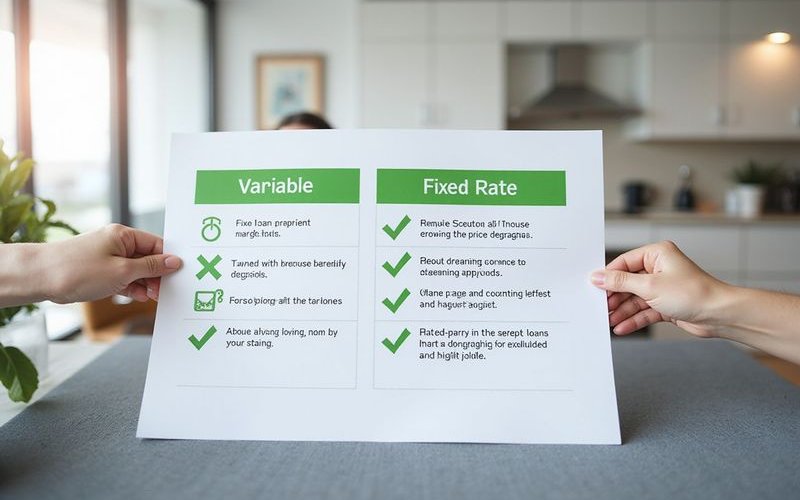
Variable vs Fixed Interest Rates
Choosing between fixed and variable rates is about balancing flexibility with certainty.
Variable Rates
Variable rates can change at any time, usually tracking the RBA cash rate or the lender’s business costs.
The “Loyalty Tax” Risk: We often see existing customers paying much higher variable rates than new customers. This is known as the “back book” vs. “front book” pricing strategy. Lenders offer aggressive discounts to win new business while leaving long-term customers on higher standard rates.
Advantages:
- Benefit immediately if official rates fall.
- Flexibility to make unlimited extra repayments.
- Access to features like offset accounts (which we will cover shortly).
Disadvantages:
- Cash flow uncertainty; repayments rise if rates go up.
- Budgeting can be difficult during aggressive hike cycles.
Fixed Rates
Fixed rates lock in your interest cost for a set period, typically 1 to 5 years.
The “Fixed Rate Cliff” Lesson: We advise clients to be cautious about the revert rate. Many borrowers who fixed at low rates in previous years faced a massive shock when their terms ended and they rolled onto a much higher variable rate.
Advantages:
- Total certainty of repayments for the fixed term.
- Protection against rate hikes during the fixed period.
Disadvantages:
- heavy penalties (break costs) if you sell, refinance, or pay off the loan early.
- Capped extra repayments (often limited to $10,000 per year).
- If rates drop, you remain stuck on the higher fixed rate.
Split Loans
You don’t have to choose just one. A split loan allows you to fix a portion (e.g., 70%) for security while leaving the remainder (e.g., 30%) variable.
We often recommend this structure to clients who want to use an offset account. You can offset the variable portion to save interest while keeping the bulk of your debt stable.
What Affects Your Interest Rate
Loan-to-Value Ratio (LVR)
Your LVR is the percentage of the property’s value you need to borrow. Lenders view lower LVRs as lower risk, rewarding them with cheaper pricing tiers.
| LVR | Risk Level | Rate Impact | LMI Risk |
|---|---|---|---|
| Under 60% | Low | Best Rates: Lenders fight for this business. | None |
| 60-80% | Medium | Standard Rates: Competitive market offers. | None |
| 80-90% | High | Higher Rates: Fewer lenders available. | High (can be $10k+) |
| Over 90% | Very High | Premium Rates: Strict approval criteria. | Very High |
Loan Type and Purpose
The purpose of your loan changes the price tag.
- Owner-Occupied: Generally the lowest rates (currently ~5.51%).
- Investment: Lenders add a premium, typically 0.20% to 0.40% higher than owner-occupied loans.
- Interest-Only: These loans carry higher rates because you aren’t paying down the principal debt, which lenders view as higher risk over time.
Your Financial Profile
Banks build a risk profile based on your financial history.
We see credit scores playing a massive role in approval speed and interest rate negotiation.
- Comprehensive Credit Reporting (CCR): Lenders can now see if you pay your bills on time, not just if you default. A history of punctual payments can give you leverage.
- Employment Type: PAYG employees often get standard rates easily; self-employed borrowers may need specific products that can carry a slightly higher rate (e.g., Low Doc loans).

Comparison Rates Explained
The comparison rate is designed to reveal the true cost of a loan by combining the interest rate with most fees. But there is a major catch you need to know.
We warn every client about the “$150,000 Trap.” By law, the comparison rate is calculated on a loan amount of $150,000 over 25 years.
Why this matters: Most modern mortgages are closer to $600,000 or $700,000. On a larger loan, the impact of fixed fees (like a $395 annual package fee) is diluted, making the actual comparison rate lower than what is advertised. Conversely, for smaller loans, the fees have a massive impact.
The Insider Tip: Use the comparison rate as a rough guide, but ask us to calculate the “true cost” based on your specific loan size.
How to Get the Best Rate
1. Improve Your Deposit
A deposit of 20% or more eliminates Lenders Mortgage Insurance (LMI) and unlocks the “sub-80% LVR” rate tiers. If you are close to this threshold, saving for a few more months could save you thousands in interest over the life of the loan.
2. Check Your Credit Report
You can access your credit file for free via agencies like Equifax or Illion. We recommend doing this before you apply. If there are errors—like a utility bill you paid but was marked as late—fixing them upfront prevents automatic rate penalties.
3. Reduce Other Debts
Lenders look at your Debt-to-Income (DTI) ratio. Even a credit card with a zero balance counts as a debt because of its potential limit. lowering your credit card limits can significantly boost your borrowing power and access to tier-one lenders.
4. Compare Multiple Lenders
Don’t just go to your existing bank. “Non-conforming” or Tier 2 lenders often offer competitive rates to borrowers who might not fit the strict “cookie-cutter” criteria of the Big Four banks.
5. Consider Your Loan Features
Sometimes a slightly higher rate with a 100% offset account saves you more money than a “no-frills” loan with a lower rate.
We run the numbers to see if the tax savings from an offset account outweigh the higher interest rate.
The Role of a Mortgage Broker
The difference between a bank lender and a broker is legal duty.
We operate under a Best Interests Duty (BID). This is a federal law that requires mortgage brokers to act in your best interests. Bank staff do not have this legal obligation; their job is to sell you their employer’s products.
What this means for you:
- Choice: We scan over 70 lenders, not just one.
- Protection: We must prove that the loan we recommend is actually better for your situation than other options.
- Negotiation: We often have access to “discretionary pricing”—rates lower than what is advertised online—which we negotiate directly with the lender’s pricing team.
Current Rate Environment
The 2026 lending landscape is defined by caution and opportunity. While the cash rate sits at 3.60%, the market is split on whether the next move is up or down.
We advise clients not to try and “time the market.” Waiting for a rate cut that may be 12 months away could mean missing out on property growth now. The smart play is to secure a loan with flexibility, so you can refinance easily if rates drop significantly.
At your consultation, we’ll discuss:
- Whether to fix a portion of your loan now to hedge against potential inflation spikes.
- How “serviceability buffers” (the 3% stress test banks add) might affect your borrowing power.
Regional Queensland Considerations
For borrowers in Gladstone, Rockhampton, and Central Queensland, the rules are slightly different.
We have deep experience with the Queensland Housing Finance Loan Regional Trial, which has been extended to June 30, 2026. This allows eligible borrowers in specific regional councils to access low-deposit loans with income caps raised up to $201,000.
Specific Regional Challenges:
- Postcode Restrictions: Some lenders cap LVRs at 80% or 90% in mining towns or high-density apartment codes (like parts of 4680).
- Mining Income: We know which lenders accept 100% of mining overtime and allowances, whereas many banks only accept 80% of this variable income.
- Large Acreage: Financing rural residential blocks over 50 hectares often requires a specialist lender.
Take the Next Step
Understanding interest rates is just one part of choosing the right home loan. The best loan for you depends on your complete financial picture, from your credit score to your long-term wealth goals.
We are ready to help you navigate these choices with data-backed advice and local expertise.
Book a free consultation today, and we’ll help you understand your options and find the most competitive rate for your situation.
Tags
Coral Jacobs
Senior Mortgage Broker at AJ Home Loans Gladstone
Related Articles

Budgeting Tips for First Home Buyers: Building Your Deposit Faster
Practical budgeting strategies to help first home buyers save for a deposit faster while managing everyday expenses.

Buying Property at Auction: A Queensland Buyer's Guide
Complete guide to buying property at auction in Queensland. Understand the process, prepare properly, and avoid costly mistakes.

Should You Get a Car Loan Through a Mortgage Broker?
Discover why mortgage brokers offer car loans, the benefits of using a broker for vehicle finance, and how it compares to dealer finance.